Careers
Small team,
senior work
How we work
The shape of the job, described as it is. If this does not sound like the environment you want, that is useful information before either of us spends time.
Small teams
Projects are staffed with the fewest people who can do the work well. Fewer handoffs, fewer meetings that exist to re-explain a decision.
Direct client contact
Engineers talk to the people whose workflow is being automated. Requirements do not arrive filtered through a layer that never saw the system.
You own what you ship
Whoever builds a component is responsible for its error handling, its monitoring and its documentation. Scope includes the parts that are easy to leave out.
Production is the bar
A demo that works once is not finished work. The standard is a system someone else can run, debug and hand over.
Open roles
No open roles right now
We are not advertising a position at the moment. We would rather publish nothing than keep a listing open to collect applications against a role that does not exist.
Speculative applications are still welcome. If your work is a close fit we will hold on to it and come back to you when there is something real to discuss.
What we look for
Not a stack list. The habits that decide whether someone can take a vague client problem and leave behind a system that keeps working.
- You can read an unfamiliar codebase and make a careful change in it without rewriting it first.
- You write plainly. Design notes, commit messages and client updates are part of the job, not overhead.
- You can describe what you do not know, and you ask before assuming. Guessing is the expensive option.
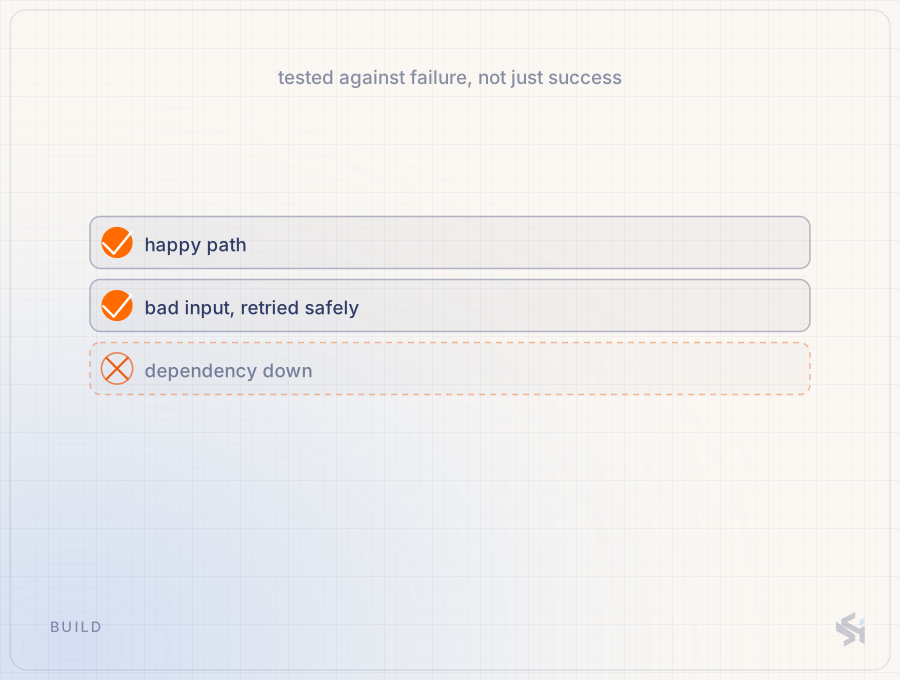
- You think about failure early: what happens on a timeout, a bad payload, a partial write, a wrong answer.
- You are comfortable working remotely and asynchronously, and you keep your work legible to people who are not online at the same time.
How hiring works
This is the process in principle, for whenever a role does open. We are not running a scheduled hiring round, so there are no dates attached to it.
A written introduction
Tell us what you have built and which part of it you would do differently now. A link to real work is worth more than a formatted CV.
A conversation
A call about your actual experience and how you reason about a system. We describe the kind of work we do and the constraints that come with it.
Something technical, scoped small
A short, paid or time-boxed exercise close to real work, or a walkthrough of code you already own. We do not run multi-day unpaid assignments.
A plain answer
We tell you yes, no, or not now, and why. If there is no role to offer, we say that rather than keeping a conversation open indefinitely.
Before you apply
The questions we get asked most often about working here.
Not necessarily. We are a small team and we only open a role when there is sustained work for it. Rather than keep a permanent listings page, we keep an open application path: if your background is a close fit we will keep the conversation on file and come back to you when a role exists.
A short note about what you have built, a link to work we can look at, and what kind of problem you want to be working on. Specifics beat a general statement of interest.
Sometimes, when a project needs a specific skill for a defined period. If that is what you are looking for, say so in your note so we match you against the right kind of work.
The work involves direct client contact and ownership of production systems, which is difficult without prior experience. We do not run a structured junior programme, so we would rather be honest than collect applications we cannot act on.
Yes. A no is more useful than silence. If we cannot place you we will tell you, and we will not keep you in an open process that is not going anywhere.
Think you would be a fit?
Send a short note with a link to your work and the kind of problem you want to be solving. We read everything that arrives and we answer either way.