A demo call is not a booking. The demo ends when a pleasant voice says "you are all set for Tuesday at ten." The system you actually have to build ends when Tuesday at ten exists in the calendar, the caller is holding a confirmation they can act on, and nobody else was offered that same slot while the agent was still talking.
Almost everything written about an AI voice agent for appointment booking is about the conversation, because the conversation is the part that demos well. In production the conversation is rarely what breaks. What breaks is the write at the end of it, the pause in the middle while a calendar is queried, and the caller who says "actually, make it Thursday" half a second after the agent committed to Tuesday.
The five jobs a booking call actually has
A booking call looks like one task. It is five, and each one has its own failure mode.
| Job | What it has to produce | How it fails |
|---|---|---|
| Identify the caller | A match to an existing record, or a new one | Two records for the same person |
| Establish the request | Service, duration, location, resource required | A slot booked for the wrong appointment length |
| Find a slot | Real availability, not a cached guess | Offering a time that was taken ten seconds ago |
| Commit the booking | One confirmed entry in the system of record | Zero bookings, or two |
| Close the loop | A confirmation the caller can act on | The caller believes they are booked and they are not |
Most teams build job three well and underbuild jobs one, four and five. Identification gets skipped because it is awkward on the phone, so the calendar slowly fills with duplicate people. The commit gets treated as a single API call that either works or does not. The confirmation gets treated as a courtesy rather than as the only evidence the caller has.
The agent's sentence is not the booking. The row in the calendar is the booking, and the caller cannot see it.
Where the latency budget goes
Callers do not perceive accuracy, at least not during the call. They perceive delay. The budget you are spending is the whole round trip: speech recognition, the model deciding what to do, any tool call it makes, speech synthesis, and the network in both directions.
For reference on the transport alone, ITU-T Recommendation G.114 puts the ceiling for a comfortable one-way voice path at around 150 ms, and treats 400 ms as the point past which interaction becomes genuinely difficult. That is the budget before your system has done any thinking at all.
In practice the bottleneck is not the speech models. It is the calendar lookup sitting in the middle of the turn. The usual pattern makes it worse: the agent proposes a time, queries availability for that one time, waits, and then speaks. Every suggestion costs a round trip to an external scheduling API, and the caller hears each one.
What helps, roughly in order of effect:
- Fetch a window, not a time. Pull the next fortnight of availability for the relevant resource once, early in the call, and answer from that. Re-verify only at the moment of commit.
- Narrow before you search. Establishing service type and rough preference first ("mornings or afternoons?") turns an open search into two or three candidates.
- Speak while you fetch. A short acknowledgement covers a lookup. Dead air does not.
- Keep the tool surface small. Each additional tool the model can choose from is another branch it can deliberate over mid-turn.
The booking write is the hard part, not the conversation
Everything up to this point is recoverable. The write is not. Four properties make it safe.
- Idempotent. Derive a key from the call itself, such as the call identifier plus the requested slot, and make the booking endpoint reject a second attempt with the same key. Voice stacks retry on timeout as a matter of routine, and a retried booking must not become two appointments.
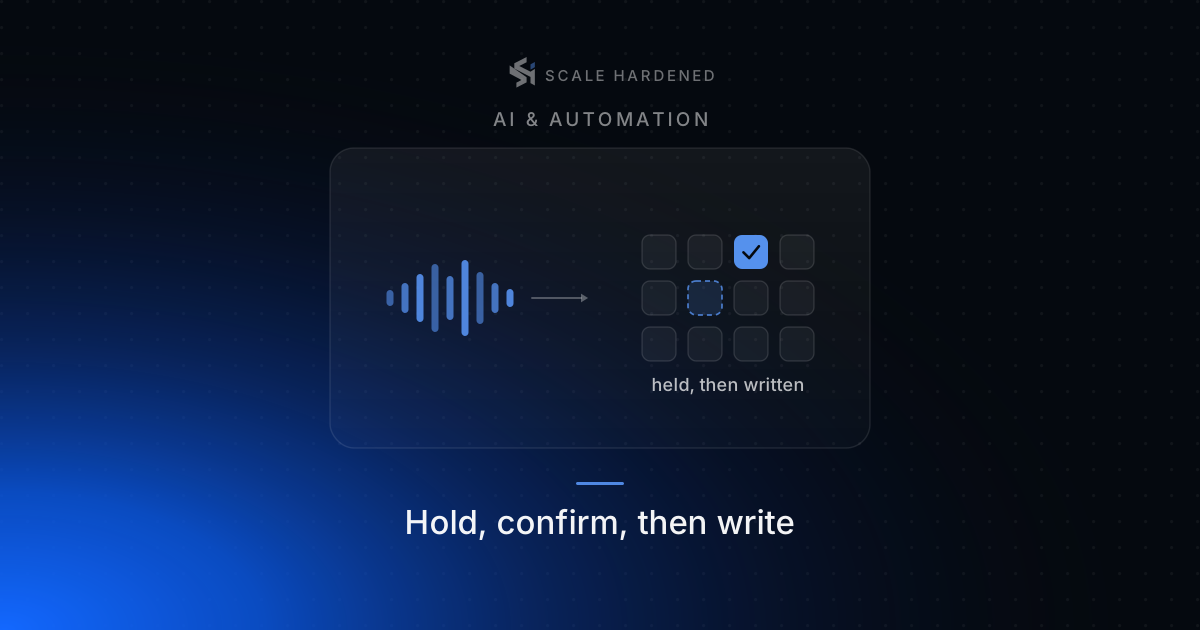
- Held, then confirmed. Place a short hold on the slot before the agent reads it back, and convert the hold to a booking only after the caller agrees. Without a hold there is a window, usually a few seconds long, in which two callers can be given the same time.
- Unambiguous about failure. A timeout is not a failure, it is an unknown. The booking may well have been created. Treat unknown as unknown: do not retry blindly, do not tell the caller they are booked, reconcile afterwards.
- Reconciled. Compare what the agent believes it booked against what the calendar actually holds, on a schedule, and surface the differences to a person. This is how you find out the hold expired, the retry duplicated, or the write silently failed for one resource.
If the write cannot be confirmed, the correct behaviour is to say so and route the call. "I am not able to confirm that booking, let me put you through to someone who can" costs one transfer. A confident confirmation of a booking that does not exist costs a customer.
Interruptions and the caller who changes their mind
Real callers interrupt. They talk over the agent, correct themselves mid-sentence, and change a decision after it has been acted on. Handling this well is mostly about distinguishing two kinds of in-flight work.
An utterance can be discarded. If the caller interrupts while the agent is speaking, stop the audio and listen. Nothing outside the call has changed.
A side effect cannot be discarded. If the caller changes the day while a hold is being placed, that hold exists in another system. Cancelling the speech does not cancel the hold.
So the design requirement is that every external action started mid-turn is cancellable and tracked:
- Keep a record of in-flight tool calls for the current turn, and release or reverse them when the turn is abandoned.
- Expire holds aggressively, in a minute or two, so an abandoned call does not quietly block a slot all afternoon.
- Treat a correction as a new turn against current state, not as an edit to the previous turn. Re-check availability for Thursday rather than assuming the Tuesday context still applies.
This is also the point where it is worth deciding, explicitly, what the agent is not allowed to finish on its own. We covered that decision in general terms in designing human escalation paths for AI agents; the booking-specific version is short, because the irreversible actions on a booking call are easy to enumerate.
Names, dates and what speech recognition reliably gets wrong
Four categories of input cause most of the real-world errors, and all four are fixable with call design rather than a better model.
Relative dates. "Next Friday" is ambiguous to people, let alone to software, and it is ambiguous differently depending on what day it is now. Resolve every relative date to an absolute one and read the absolute one back: "Friday the twenty-first of November."
Time zones. The caller's zone, the business's zone, and the calendar's stored zone are three different things, and they diverge on exactly the weekend the clocks change. Store in UTC, display in the business's zone, and state the zone out loud when a caller might be elsewhere.
Names and email addresses. Speech recognition is weakest precisely where the stakes are highest. Capture the name, then spell it back. For an email address, spell it back character by character, or avoid capturing it by voice at all and send a link by SMS to the number that called.
Numbers. Phone numbers and reference codes should be read back in groups, and confirmed, not assumed. A misheard digit in a callback number turns a successful booking into an unreachable customer.
Consent, disclosure and recording
This is the part that gets skipped in a prototype and is non-negotiable in production.
In the United States, the FCC confirmed in a February 2024 declaratory ruling that AI-generated voices count as "artificial" under the Telephone Consumer Protection Act. The headline framing was that AI voices in robocalls became illegal; the substance is narrower and more useful to understand. The ruling did not ban the technology. It confirmed that the existing consent requirements for artificial and prerecorded voice calls apply to it.
Practically, that means the compliance weight falls on outbound calling, where prior express consent is the issue. An inbound call that a customer placed to your published number sits in a different posture. Recording is a separate question again, governed by state and national law rather than by that ruling, and some jurisdictions require every party to consent.
None of the above is legal advice, and the details change. What belongs in the build regardless:
- Disclose that the caller is speaking to an automated assistant, early and in plain language.
- Offer a route to a person at any point, and make the phrase that triggers it obvious.
- Record the consent you relied on, per call, in a form you could produce later.
- Keep recordings and transcripts under a retention policy somebody has actually approved.
Where it still struggles
An honest list, because these cases arrive whether or not they were designed for.
- Multi-party calls. One person calls, then hands the phone to the person whose appointment it is, or puts the agent on speaker in a room of three. Turn-taking degrades badly.
- Poor audio. A bad line, a loud forecourt, a hands-free car. The agent cannot confirm a name it cannot hear, and the honest move is a transfer.
- Constrained rescheduling. "Move it to the same week but not Wednesday, and only if the same practitioner is free" is a constraint-satisfaction problem, not a conversation.
- Distress and urgency. Medical, legal and financial urgency is not a routing problem. These calls should reach a person quickly, and detecting them is a design requirement, not an optimisation.
- Policy exceptions. Anything requiring judgement about whether to bend a rule is the wrong work to automate. The agent should know the rule and know who owns the exception.
- Low volume. A line taking a few calls a week will not repay the build, the monitoring, or the maintenance. This is the most common reason a voice agent is the wrong answer, and it has nothing to do with the technology.
The split that tends to hold up in practice:
| Route to the agent | Route to a person |
|---|---|
| New booking for a standard service | Anything needing a policy exception |
| Reschedule or cancel with a known reference | Complex multi-constraint rescheduling |
| Availability and opening-hours questions | Complaints and billing disputes |
| Intake and qualification before a callback | Distressed, urgent or safeguarding calls |
| Overflow when every person is already on a call | Calls where identity cannot be confirmed |
That last row on the left is worth noticing. The strongest early case for a voice agent is usually not replacing a receptionist. It is answering the calls that currently reach nobody, after hours and during the lunch hour, which is also the easiest case to measure honestly. Appointment-heavy sectors feel this most: see how this plays out for real estate or healthcare administration, where a missed call is a lost instruction rather than a missed conversation.
A short deployment checklist
- Write down the five jobs for your specific call, and name the system of record for each one.
- Define the scope boundary: the exact list of things the agent may complete without a person.
- Build the hold-then-confirm write with an idempotency key before building any conversation polish.
- Resolve every date to an absolute date and every time to a zone, and read both back.
- Add a spell-back step for names, and avoid capturing email addresses by voice.
- Make the transfer path work first, and test it under failure rather than on a happy path.
- Instrument per-turn latency, tool-call latency, transfer rate with reasons, and booking reconciliation differences.
- Run a reconciliation pass daily for the first month and read the output yourself.
An AI voice agent for appointment booking is a good piece of engineering when it is treated as a transaction system with a voice interface. It is a liability when it is treated as a conversation that happens to end in a booking. The difference shows up in the calendar, not in the transcript.
If you are scoping one, see how we build voice agents or book a strategy call and we will walk through your actual call flow, including the parts that should stay with a person.